Introduction
This project explores the child adoption ecosystem in India through a service design lens, focusing on the gap between procedural clarity and emotional preparedness in the adoption journey. While existing systems communicate legal and administrative processes to some extent, they fail to support the lived, emotional and social realities experienced by adoptive families.
Through qualitative research with pre-adoptive parents, post-adoptive parents and adoption NGOs, this study uncovers the absence of a trusted, structured space for peer-to-peer knowledge exchange. The outcome is a meso-level service blueprint for an NGO-anchored, CSR-funded community platform that enables safe, moderated exchange of lived adoption experiences, bridging institutional processes and human realities.
Rather than proposing a standalone digital product, this case study demonstrates how community can function as social infrastructure and how sustainability can be achieved through alignment with existing NGO networks and CSR funding models within the child welfare ecosystem.
Research & Design Process Flow
- Brainstorming
- Ideation
- Persona creation
- Journey Mapping
- Policy review (CARA guidelines)
- NGO adoption frameworks
- CSR adoption & child welfare reports
- Structured interviews with pre-adoptive parents
- In-depth conversations with post-adoptive parents
- Expert interviews with NGOs
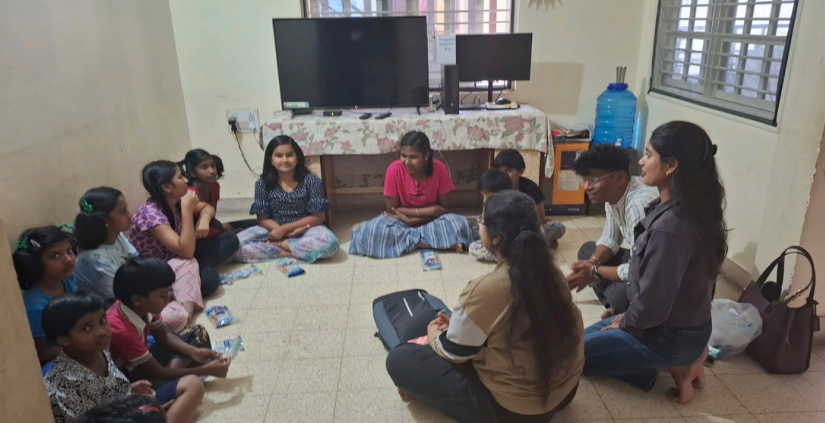
- Informal conversations with children at adoption centres
- Stakeholder Mapping
- Ecosystem Mapping
- Affinity Mapping
- Lotus Blossom
- Empathy Mapping
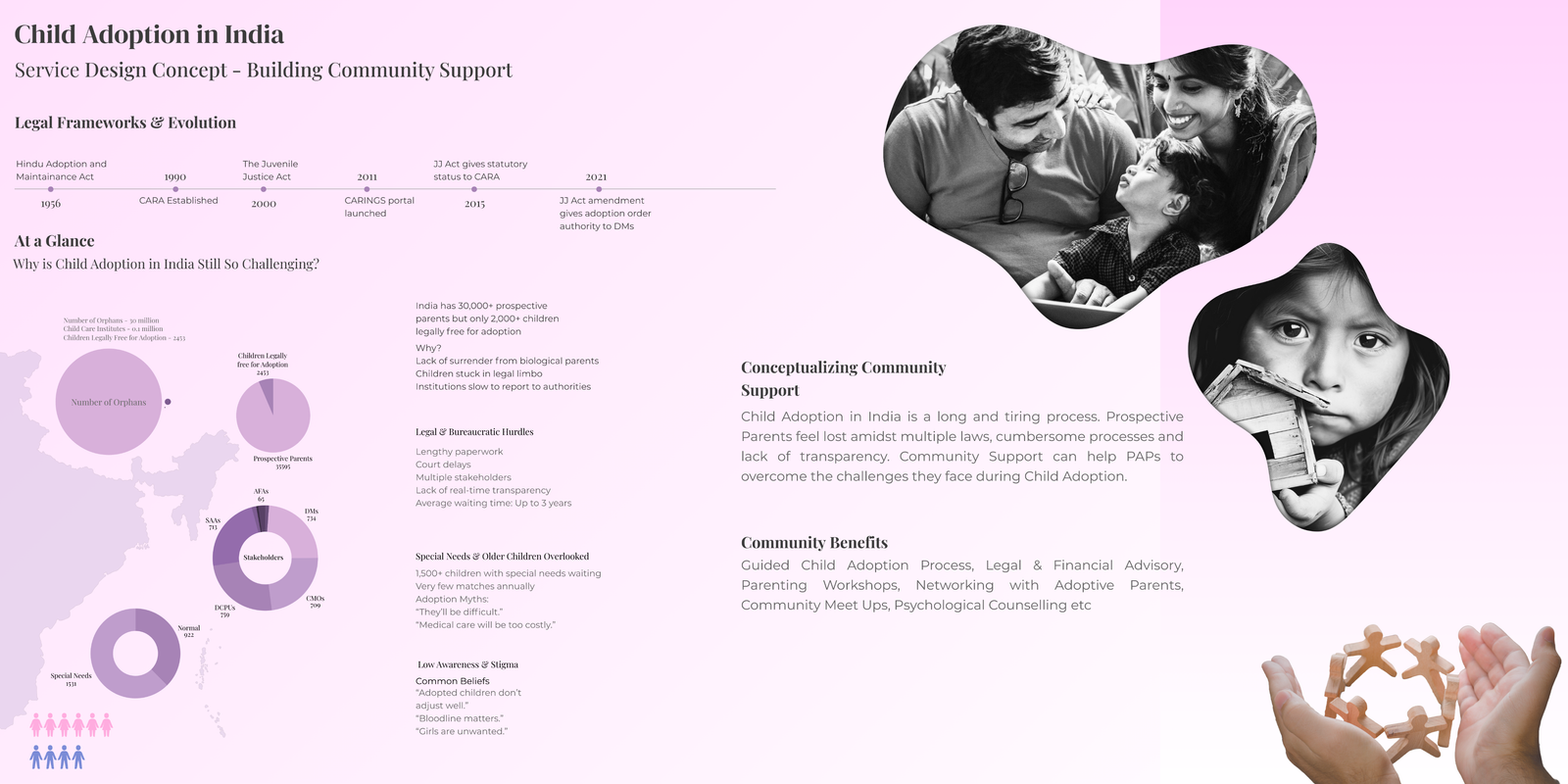
Legal Frameworks & Timeline
Guardians and Wards Act
- Early law for guardianship (not full adoption)
- Applied mostly to those persons who didn't permit full adoption
Hindu Adoption and Maintenance Act
- First modern adoption law for Hindu, Jains and Buddhists
- Gave legal framework for adoption with parental rights and provisions
CARA Established
- CARA set up by MOCA as an autonomous body under the MOWCD
- India's public oversight body for adoption cases especially for abandoned, surrendered or parentless children
2003
Hague Convention
- India becomes party to the Hague Convention to regulate international adoption standards
- Established Central Authority for inter-country adoption under this convention
CARINGS Portal
- CARA's Child Adoption Resource Information and Guidance System (CARINGS) was introduced to digitize adoption procedures
- Enabled online registration, tracking, and data sharing between CARA and SAAs
- By 2015, widely used by both parents and SAA institutions
Juvenile Justice Act Provisions
- First major parent-centric act including socio-adoption provisions
- Replaced earlier J.J Act (pre 2000)
New J.J Act
- New Act replaced the 2003 Act
- CARA made a mandatory body under this Act
- Adoption procedures detailed in the new legislation made mandatory for all religions
- Prospective parents must register with CARA
- Home Study Report by a specialized agency made mandatory
- Previously, Adoption orders were given by family courts
J.J Act Amendments
- Came into force in September 2022
- District Magistrate (DM) instead of courts to issue adoption orders, aiming to reduce delays
Adoption Regulations
- Adoption procedures follow under the J.J Act
- Included new mandatory timelines
- Gave new role & status updates to CARINGS
Raw Research Insights
Secondary Research — Key Insights
- Indian adoption laws strongly prioritize child protection and legal safeguards
- Digitization (CARA) has improved procedural efficiency, not emotional experience
- Adoption is widely acknowledged in research as a psychosocial process, not just legal
- Mental health and emotional preparedness are under-integrated in formal adoption systems
- Post-adoption adjustment and disclosure are recurring concerns in Indian adoptive families
- NGOs often act as emotional mediators, beyond their formal mandate
- Academic literature highlights the need for support systems beyond documentation
Primary Research — Raw Field Insights
- Parents perceive the process as mechanical, long and emotionally exhausting
- There is a lack of legal clarity
- Parents feel “informed but unsupported”
- Children experience prolonged waiting and repeated transitions
- Children’s emotional states are rarely surfaced or discussed explicitly
- Parents trust other parents’ lived experiences more than official guidance
- Informal peer support exists but is fragmented and invisible
- NGOs carry significant emotional labor without scalable tools
- No clear space exists for pre and post-adoption continuity
Research Gigamap
Stakeholder & Ecosystem Mapping
Adoption Scenarios — Pre & Post CARA (CARINGS)
Research Synthesis
User Journey Maps & Personas
Affinity Mapping
Empathy Mapping — Parents Centric Lens
Ideation — Lotus Blossom
HMVs & Focussed Solutioning
Multiple researcher lenses enabled divergent ideation, while all solutions converged on a community-anchored, NGO-led adoption support ecosystem.
Designing
Service Blueprint — MESO LEVEL
Awareness & Registration
Home Study & Evaluation
Matching & Referral
Legal Process
Post-Adoption
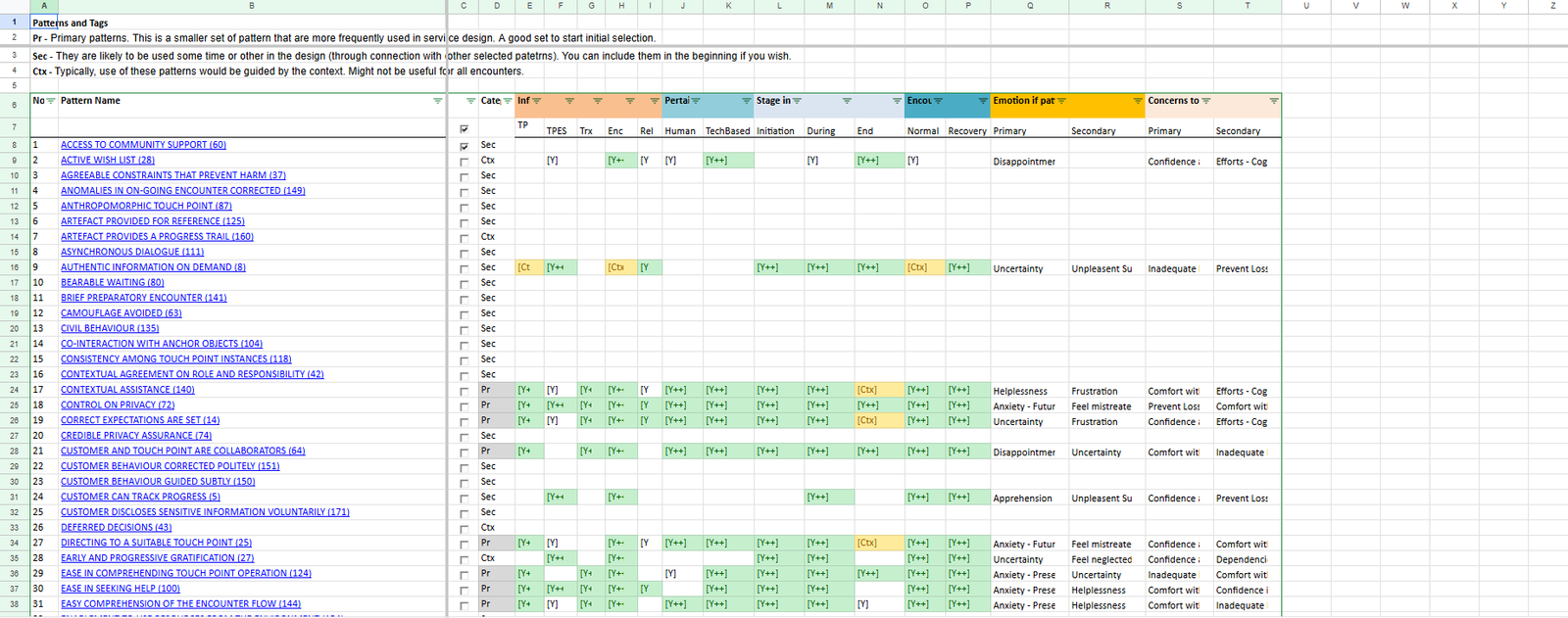
Pattern Language
A Pattern Language for Service Design is a structured way of understanding and solving common service design challenges. It provides a collection of patterns, which are reusable solutions to recurring problems in service design. Each pattern describes a problem, its context, and a tested solution that can be adapted to different services.
It’s like a tool in a toolbox which gives designers structured guidelines to create effective and user-friendly services.
The Pattern Language for Touchpoint ecosystem utilized in this project is devised by Dr. Pramod Khambete — Consultant Adjunct Professor, IDC School of Design, IIT Bombay.