OVERVIEW

Attenly

CATEGORY/ SELECTED WORKS

YEAR/ 2020

CLIENT/

Status/Completed

Project Duratıon/4 weeks

Industry/Plant-Based Functional Beverages

Deliverables/Billboard design, street posters, metro wrap ads, launch catalog, product sampling guide

Launch Date/March 2020

UI/UX Case Study

Designing Attenly — A Child-Centric ADHD Screening App

A collaborative screening tool for parents and teachers to enable early recognition of ADHD symptoms in children aged 6-12, supporting timely professional intervention.

Role

Freelance Product Designer
Research, Concept Development & Visual Design

Timeline

8 Weeks

Methods

Literature Review, Contextual Inquiry, Surveys, Interviews

Tools

Figma, FigJam, Adobe Illustrator, Adobe Photoshop, Notion, Zotero, Canva

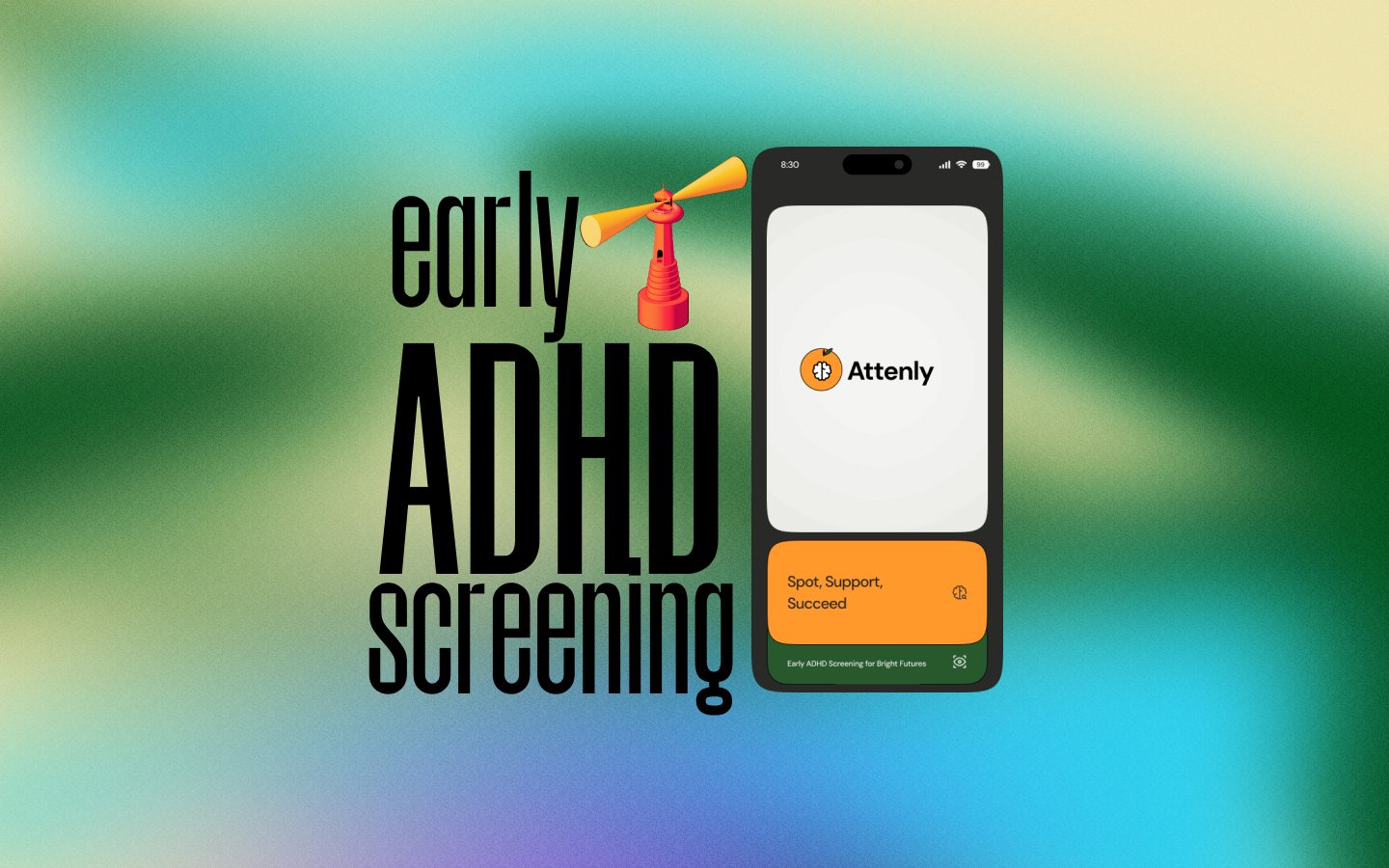
Attenly ADHD Screening App Hero
The Challenge

ADHD often goes unidentified in early childhood, despite symptoms appearing between ages 6-12

Across global education and pediatric systems, ADHD frequently goes unrecognized despite symptoms commonly emerging in early childhood. While early recognition is critical for academic, emotional and social outcomes, delayed identification remains widespread. A key challenge is that early ADHD symptoms often overlap with typical childhood behaviours, making it difficult for caregivers to distinguish between normal development and clinically significant concerns.

It was a client project. I chose this project because it sits at the intersection of healthcare, education and behaviour-led design, where early intervention can significantly change outcomes. ADHD is often missed in its early stages due to limited awareness and lack of accessible screening tools. This project allowed me to explore how research-driven design can support early awareness and enable timely professional intervention.

Process Overview

Research-Driven Design Process

Design Brief
Divergence
1
Understanding the Brief & Defining the scope
2
Literature Review
3
Contextual Inquiry
Transformation
4
Journey Mapping & Personas, Affinity Mapping
5
Synthesising insights & Ideation
Convergence
6
App Information Architecture and Wireframes
7
Brand Identity & UI Design
8
Prototyping
9
Testing
Final Interface
Understanding the Brief

Understanding the brief

ADHD often goes unrecognized in early childhood due to symptom overlap with normal behavior. Although early identification improves academic, emotional and social outcomes, caregivers struggle to distinguish clinically significant patterns, revealing a need for clearer, supportive early-screening tools

Line of inquiry

- What factors contribute to ADHD going unrecognized in early childhood and who are the stakeholders and how do they perceive and interpret early symptoms that often resemble typical behaviours?

- Are there any social, awareness or systemic barriers which lead to ADHD going unnoticed or ignored.

- And how do varying perspectives influence who feels responsible for identifying potential signs and initiating early screening in the first place?

Secondary Research

Literature Review

1

Behaviour appears developmentally typical

Early inattention, hyperactivity, and emotional variability resemble normal childhood behaviour, making impairment difficult to judge. (Wolraich et al., 2019)

2

Context-dependent reporting

Parents and teachers often report symptoms differently across settings, leading to hesitation and delayed screening. (De Los Reyes & Kazdin, 2005)

3

Less disruptive symptoms overlooked

Inattentive presentations are less likely to trigger concern because they cause fewer behavioural disruptions. (Willcutt et al., 2012)

4

Comorbidity obscures identification

Anxiety, mood, or learning difficulties may mask ADHD or be addressed first. (Cortese et al., 2022)

5

Systemic and social barriers

Stigma, limited awareness, insufficient screening time, and poor coordination between schools and healthcare delay identification. (Visser et al., 2015; Wolraich et al., 2019)

6

Clinical implication

ADHD frequently co-occurs with depression, reinforcing the need for early, routine screening that also considers emotional symptoms. (Cortese et al., 2022; Garcia-Argibay et al., 2024)

Primary Research

Stakeholder & Ecosystem Mapping

Child age 6–12

Parents / Primary Caregivers

Home context, daily observations

Class Teacher

Classroom behavior, academic tracking

Family Doctor

First medical point of contact

School Administrator

Policy, support systems

Developmental Pediatricians

Specialist assessment

Child Psychologists

Behavioral evaluation

Psychiatrists

Diagnosis & medication

Behavioral Therapists

Intervention strategies

Occupational Therapists

Sensory & motor support

Subject Teachers

Cross-subject observations

School Counselors

Emotional support

Special Educators

Resource teachers

Tuition / Coaching Centers

After-school learning context

Extended Family

Generational views on behavior

Peer Parents

Community comparison & support

Online Forums & WhatsApp Groups

Informal information exchange

Social Media & Misinformation

Cultural beliefs, stigma

Education Boards

Curriculum & inclusion policies

Insurance Systems

Coverage for assessments

School Inclusion Policies

Accommodation frameworks

Healthcare Policy Bodies

Standards & guidelines

Primary Care Clinics

First screening access point

Contextual Enquiry

Contextual Enquiry

Methods Used

Field Visits

  • Classrooms: Attention demands, behavioral expectations, reporting mechanisms
  • Homes: Parental interpretation, coping strategies, normalization or concern
  • Primary care settings: Time-limited consultations, screening workflows, referral decisions
  • School-clinic coordination: Information handoff and follow-up gaps

Stakeholder Interviews (Semi-Structured)

  • 8 teachers
  • 10 parents
  • 2 psychologists

Goals: Understand challenges, expectations, emotional pressures.

Surveys

  • 35 parents
  • 32 teachers
  • 4 psychologists

Goals: Measure awareness, common misconceptions, readiness to use a screening tool.

Research Goals

ADHD awareness in parents Parents' mental models Teachers' pain points "Normal" vs "concerning" behavior Screening action triggers Responsibility gaps Time, stigma & tool constraints
Key Findings

Primary Research Insights

Parents

Sample size: 35
76% Struggle to tell ADHD apart from "normal energetic behavior."
63% Fear social stigma associated with seeking psychiatric help.
58% Feel guilty or anxious when reading about symptoms online.
82% Want a non-judgmental, simple way to understand behaviors.
70% Prefer a handy tool that "just screens, not diagnoses."

Teachers

Sample size: 32
68% Report behaviour concerns earlier than parents.
54% Hesitate to share concerns due to fear of offending parents.
72% Want a standardized tool for rating attention and activity levels.
90% Suggest collaborating with parents for screening.

Psychologists

Sample size: 4
Stress the need for use of validated tools (Vanderbilt & CES-DC)
Combined reporting (parent + teacher) for more accurate screening
Suggest making non-diagnostic modality for early screening
Research Synthesis

Research Gigamap

User Research

Journey Mapping, Personas & Affinity Mapping
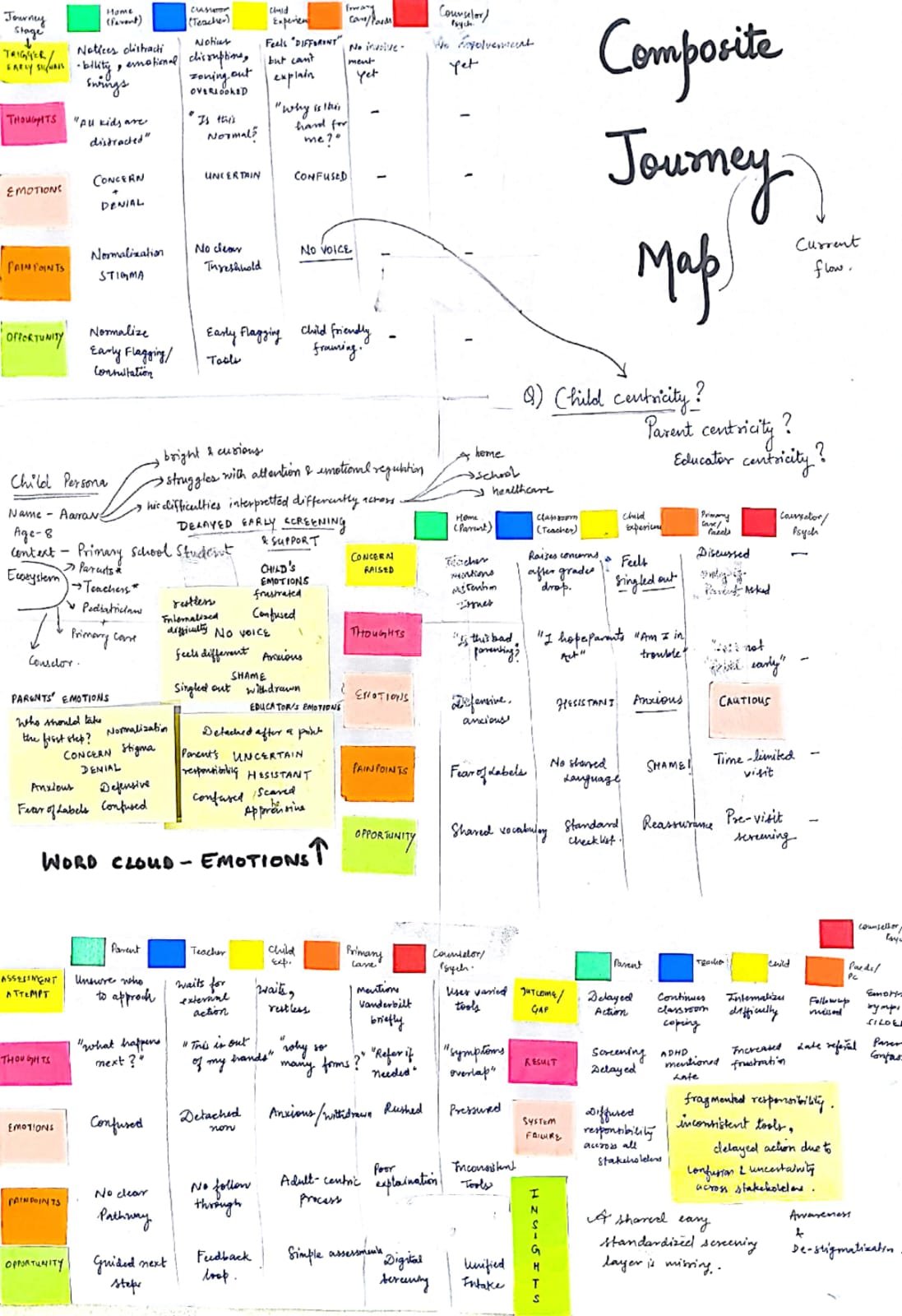
Scroll to explore
Teacher
Ms. Rao · Age 42 · Primary school teacher
Observe
Manage in Class
Escalate (Late)
After Escalation
User Actions
Notices repeated disruptions; quiet inattention often missed
Uses reminders, seating changes, redirection
Mentions concern only after grades drop
Suggests “monitoring” or informal discussion
Thoughts
“Is this normal kid behavior?”
“I’ll handle it myself”
“Is this ADHD or just effort?”
“I hope parents take this seriously”
Pain Points
No clear threshold
No checklist or system
Fear of mislabeling
No structured next step
Opportunities
Early signals
Lightweight screening
Shared language
Clear escalation workflow

About

Manages a large classroom and relies on experience and intuition to handle behavioral challenges.

Behaviors & Needs

  • Notices disruption before inattention
  • Uses classroom strategies before referrals
  • Unsure when to escalate concerns

Pain Points

  • No standardized screening tools
  • Time pressure and unclear responsibility

Goal: To support students without mislabeling or overstepping.

Scroll to explore
Parent
Neha · Age 36 · Working parent
Notice
Normalize / Explain Away
Seek Clarity
Decide Next Steps
User Actions
Observes distractibility, emotional swings
Blames screens, stress, parenting
Talks to teacher or searches online
Hesitates to approach doctor or school
Thoughts
“Something feels off”
“All kids are like this”
“Who should I trust?”
“Will this label harm my child?”
Pain Points
Stigma
Conflicting narratives
No guidance
Fear of medication
Opportunities
Normalize early consultation
Reframe ADHD
Clear first step
Non-diagnostic but suggestive tools

About

Wants to support her child but is overwhelmed by conflicting information, stigma around ADHD and fear of labeling or medication.

Behaviors & Needs

  • Normalizes early symptoms
  • Searches online before seeking help
  • Hesitant to initiate formal screening
  • Wants clarity, not diagnostic labels

Pain Points

  • Fear of judgement or long-term records
  • No clear first step or guidance
  • Conflicting opinions from school and doctors

Goal: To understand what’s happening and act early without harming her child.

Scroll to explore
Child
Aarav · Age 8 · Primary school student
Classroom Experience
Feedback Loop
Assessment Setting
After Assessment
User Actions
Struggles to focus or sit still
Receives repeated corrections
Waits, fills forms indirectly
Behavior discussed without child
Thoughts
“Why is this hard?”
“I’m always in trouble”
“What is happening?”
“Is something wrong with me?”
Pain Points
No explanation
Negative reinforcement
Adult-only language
Emotional needs sidelined
Opportunities
Child-inclusive tools
Strength-based framing
Short, engaging screening
Emotional validation

About

Curious, imaginative and verbally expressive, but struggles with sustained attention, emotional regulation and task completion — especially in structured classroom settings.

Behaviors & Needs

  • Gets distracted easily; often “zones out”
  • Reacts emotionally when corrected
  • Performs well in areas of interest
  • Struggles with routine/monotonous tasks

Pain Points

  • Feels “different” but doesn’t understand why
  • Receives negative feedback more than guidance
  • Emotional struggles are unnoticed or misinterpreted

Goal: To feel understood and supported, not blamed.

Scroll to explore
Primary Care / Pediatrician
Dr. Sharma · Age 48 · General Pediatrician
Intake
Discussion
Screening
Follow-Up
User Actions
Addresses parent-raised concerns only
Hesitates to label
Mentions Vanderbilt briefly
Refers late or follow-up missed
Thoughts
“Limited time”
“Don’t overdiagnose”
“This should be handled elsewhere”
“Parents will follow up”
Pain Points
Time Limits
Unclear thresholds
Tools not explained
No tracking
Opportunities
Pre-visit screening
Standard protocols
Integrated tools
Automated follow-ups

About

First medical point of contact for most families, managing a high patient load with limited consultation time. Approaches diagnosis cautiously to avoid premature labeling.

Behaviors & Needs

  • Focuses on immediate physical concerns first
  • Discusses ADHD only if parents raise it
  • Mentions screening tools briefly without detailed explanation
  • Prefers to “wait and watch” before referring

Pain Points

  • Short consultation windows (10–12 minutes)
  • Incomplete input from teachers and parents
  • Fear of over-diagnosis or parental pushback

Goal: To balance early identification with responsible, non-hasty medical decisions.

Scroll to explore
Counselor / Psychologist
Dr. Mehta · Age 45 · School / Child psychologist
Waiting & Intake
Assessment
Interpretation
Feedback
User Actions
Parents fill repeated forms
Uses varied tools
Separates attention & mood
Shares results late
Thoughts
“System is overloaded”
“Which tool fits?”
“These overlap”
“This is a lot for parents”
Pain Points
Long waits
Inconsistency
Siloed findings
Parent confusion
Opportunities
Unified intake
Standardized tools
Combined screening
Clear explanations

About

Works with limited time and resources, balancing diagnostic accuracy with system constraints.

Behaviors & Needs

  • Uses multiple assessment tools
  • Addresses attention and mood separately
  • Presents findings cautiously

Pain Points

  • Inconsistent referrals
  • Parents overwhelmed by process
  • Fragmented information from schools and clinics

Goal: To identify concerns early and guide families clearly through next steps.

Affinity Mapping

Primary & Secondary Research Insights

Parents
Teachers
Psychologists
Primary Care Physicians
Secondary Insights
When I search symptoms online, everything sounds scary and overwhelming.
parent survey
I feel guilty thinking something might be wrong with my child.
parent interview
I don’t know if my child’s energy is normal or if it’s something I should worry about.
parent survey
I thought ADHD only meant hyperactivity; I didn’t know inattentive type existed.
parent survey
I worry about the stigma — people judge children so quickly.
parent interview
It’s hard to observe their behavior objectively. I tend to see it emotionally.
parent interview
I want something simple that tells me if I should seek help.
parent survey
I want to understand the behaviors without feeling attacked.
parent interview
I want a tool that helps both me and the teacher be on the same page.
parent survey
Some parents are not aware of learning and hyperactivity disorders like ADHD.
teacher interview
I often notice attention deficits before parents do.
teacher interview
Some behavior only shows in structured environments like classrooms.
teacher survey
I need a neutral tool to communicate what I’m seeing.
teacher interview
Parents get defensive when I raise concerns.
teacher interview
I don’t have time for long assessments.
teacher survey
I need structured questions that reflect the real classroom behavior.
teacher interview
A scoring system would make it easier to show patterns over time.
teacher survey
Vanderbilt aligns with DSM criteria and works well when both parent and teacher complete it.
psychologist interview
Parent-teacher discrepancies are expected; combined data is far more accurate.
psychologist interview
CES-DC is one of the few tools validated for childhood depressive symptoms at this age.
psychologist interview
Vanderbilt is what we already use in clinics — it’s familiar.
psychologist interview
SNAP-IV is easy but not comprehensive enough for nuanced screening.
psychologist interview
Parents usually come to me after school raises concerns.
PCP interview
A combined report from parent and teacher saves me a lot of consultation time.
PCP interview
There is a need to create awareness. So many unaware parents come to me.
PCP interview
Parents complain about their child being stigmatized at school.
PCP interview
I need structured screening before referring to specialists.
PCP interview
Research shows 30–50% discrepancy between parent and teacher ratings.
literature review
Combining informants significantly improves screening accuracy (De Los Reyes & Kazdin, 2005).
literature review
Vanderbilt includes symptom impairment questions — others often don’t.
literature review
CES-DC is validated for ages 6–17 and simple enough for non-clinical use.
literature review
Conners-3 and BASC-3 require expert training and are not suitable for self-administered digital use.
literature review
Vanderbilt’s scoring maps well to digital automation.
literature review
CES-DC uses straightforward frequency-based scoring ideal for mobile UI.
literature review
Both are freely available for non-commercial use removing licensing barriers.
literature review

Iteration 1 — Identifying Themes for each Stakeholder Group

Parents
Teachers
Psychologists
Primary Care Physicians
Secondary Insights
What is ADHD? Never heard that before.
awareness
I don’t know if my child’s energy is normal or if it’s something I should worry about.
awareness
When I search symptoms online, everything sounds scary and overwhelming.
awareness
I thought ADHD only meant hyperactivity; I didn’t know inattentive type existed.
awareness
What if teachers think I’m a bad parent?
stigma
I worry about the stigma — people judge children so quickly.
stigma
I feel guilty thinking something might be wrong with my child.
stigma
It’s hard to observe their behavior objectively. I tend to see it emotionally.
observation
I don’t know what exactly teachers observe at school.
communication
I want something simple that tells me if I should seek help.
tools
If a test is standardised, I’ll trust it more than random blogs.
tools
I want to understand the behaviors without feeling attacked.
communication
I want a tool that helps both me and the teacher be on the same page.
tools
Some parents are not aware of learning and hyperactivity disorders like ADHD.
awareness
I often notice attention deficits before parents do.
observation
Some behavior only shows in structured environments like classrooms.
observation
I need a neutral tool to communicate what I’m seeing.
tools
Parents get defensive when I raise concerns.
stigma
I don’t have time for long assessments.
workflow
If the tool is confusing, I can’t use it during a busy school day.
workflow
I need structured questions that reflect the real classroom behavior.
tools
A scoring system would make it easier to show patterns over time.
tools
I want the tool to differentiate between occasional misbehavior vs consistent symptoms.
tools
Vanderbilt aligns with DSM criteria and works well when both parent and teacher complete it.
validation
Parent-teacher discrepancies are expected; combined data is far more accurate.
validation
CES-DC is one of the few tools validated for childhood depressive symptoms at this age.
co-morbidity
Vanderbilt is what we already use in clinics — it’s familiar.
adoption
SNAP-IV is easy but not comprehensive enough for nuanced screening.
tools
Conners and BASC require licensing and are too long for primary care.
tools
Screening tools must not imply diagnosis.
ethics
Users need clear, non-judgmental feedback with next steps.
communication
Consistency across informants improves early identification.
validation
Parents usually come to me after school raises concerns.
referral
A combined report from parent and teacher saves me a lot of consultation time.
tools
There is a need to create awareness. So many unaware parents come to me.
awareness
Parents complain about their child being stigmatized at school.
stigma
I need structured screening before referring to specialists.
workflow
Research shows 30–50% discrepancy between parent and teacher ratings.
literature
Combining informants significantly improves screening accuracy (De Los Reyes & Kazdin, 2005).
literature
Vanderbilt includes symptom impairment questions — others often don’t.
literature
CES-DC is validated for ages 6–17 and simple enough for non-clinical use.
literature
Conners-3 and BASC-3 require expert training and are not suitable for self-administered digital use.
literature
Vanderbilt’s scoring maps well to digital automation.
literature
CES-DC uses straightforward frequency-based scoring ideal for mobile UI.
literature
Both are freely available for non-commercial use removing licensing barriers.
literature

Clustering Themes

Awareness & Knowledge Gaps

Parents are not aware about Hyperactivity & Inattention Disorders like ADHD
Teachers know general but lack specialized knowledge
Parents confuse ADHD with lack of motivation
Both groups misidentified normal childhood symptoms as ADHD
Academic early childhood behavioral issues hard to differentiate from symptoms
Not enough educational resources available for stakeholders

Barriers & Stigma

Parents feel guilt, fear, anxiety
Stigma prevents early action
Teachers fear upsetting parents

ADHD & Depression are co-morbid

Depression can mimic or mask ADHD symptoms
Co-occurring conditions need simultaneous screening

Communication Breakdowns

Parents and teachers lack a shared language to discuss concerns
PCPs need structured reports
Discrepancies in behavioral observations across settings
Reports don’t reach parents in understandable format

Practical Workflow Constraints

Teachers lack time
Parents need clarity
Tools must be short, simple, accessible

Suitability of Screening Tools

Vanderbilt fits DSM criteria and is designed for teacher settings
CES-DC validated for young children
Alternatives are lacking; few short screening options available
Synthesis

Synthesising & Ideation

01

ADHD is often missed early due to symptom overlap with normal childhood behavior and inconsistent interpretation across home and school contexts.

02

Contextual inquiry revealed fragmented observations, unclear ownership of screening, and lack of shared documentation between parents, teachers and clinicians.

03

Literature highlights frequent ADHD comorbidity with mood disorders, increasing the risk of missed or delayed identification.

04

Standardized, validated tools (Vanderbilt for ADHD and CES-DC for depressive symptoms) address variability and capture co-occurring risks.

A digital, low-cost screening solution can enable joint parent-teacher input, immediate next-step recommendations, and scalable adoption.
Such a tool serves as a first, non-diagnostic step, supporting early recognition before formal clinical evaluation.
Envisioned an ADHD & Depression screening app for parent-teacher input and validated the idea with the stakeholders.
Ideation

Crazy 8

Classroom Observation Tool

Hits data capture + Doesn’t support diagnosis

Parent Support Companion + Data Capture + Expert Payoff Insights

Helps immediate classroom management + Low-tech & scalable

Awareness Workshops + Resources

Needs verified doctors + Higher institutional cost. Empathy + belonging + accelerates professional help

Gamified Screening Tool

Easy to validate clinically + requires long iterative research. Data-driven & engaging + standardized

CRAZY 8

8 rapid ideation concepts

Observe, Model & Activity Exercise Insights

Continuous tracking + Supports narrative over score-based approach. High scaffolding impact

Validated Screening Test for Children

Personalized insights + Data-driven screening & tracking. Requires more data first + objective vs screening

Wearable + Sensory Monitor

Hardware cost + Not useful without prior screening baseline. Continuous tracking + Supports objective data

ADHD Parent Community App

First step before clinical assessment. Dependent on self-reporting accuracy + May need cultural interpretation

Solution

Envisioning Attenly - A Child Centric, Collaborative ADHD Screening app for parents and teachers

Information Architecture & Wireframes

Information Architecture

Key Features
User Types
Parents
Teachers
Outpatient Clinicians
Account Management
Create and manage accounts for users
Questionnaires
Fixed multiple-choice and free-text questions
Include specific screening tools
Data Management
Export responses to Excel
Admin panel for data viewing
Compliance and Privacy
Encrypt data storage
Include consent forms
Comply with various regulations
Display privacy policies
ADHD Screening App
Design Considerations
Steps for UX Design
UI/UX
User-friendly design
Responsive layouts
Visual elements
Focus on usability
Technologies
React JS for web, React Native for mobile
Node.js for backend API
Feedback and Compliance
Develop MVP and gather feedback
Ensure legal compliance
Research User Personas
User Journey Maps
Wireframes and Prototypes
Usability Testing
Iterate and Refine
Final Design Specs

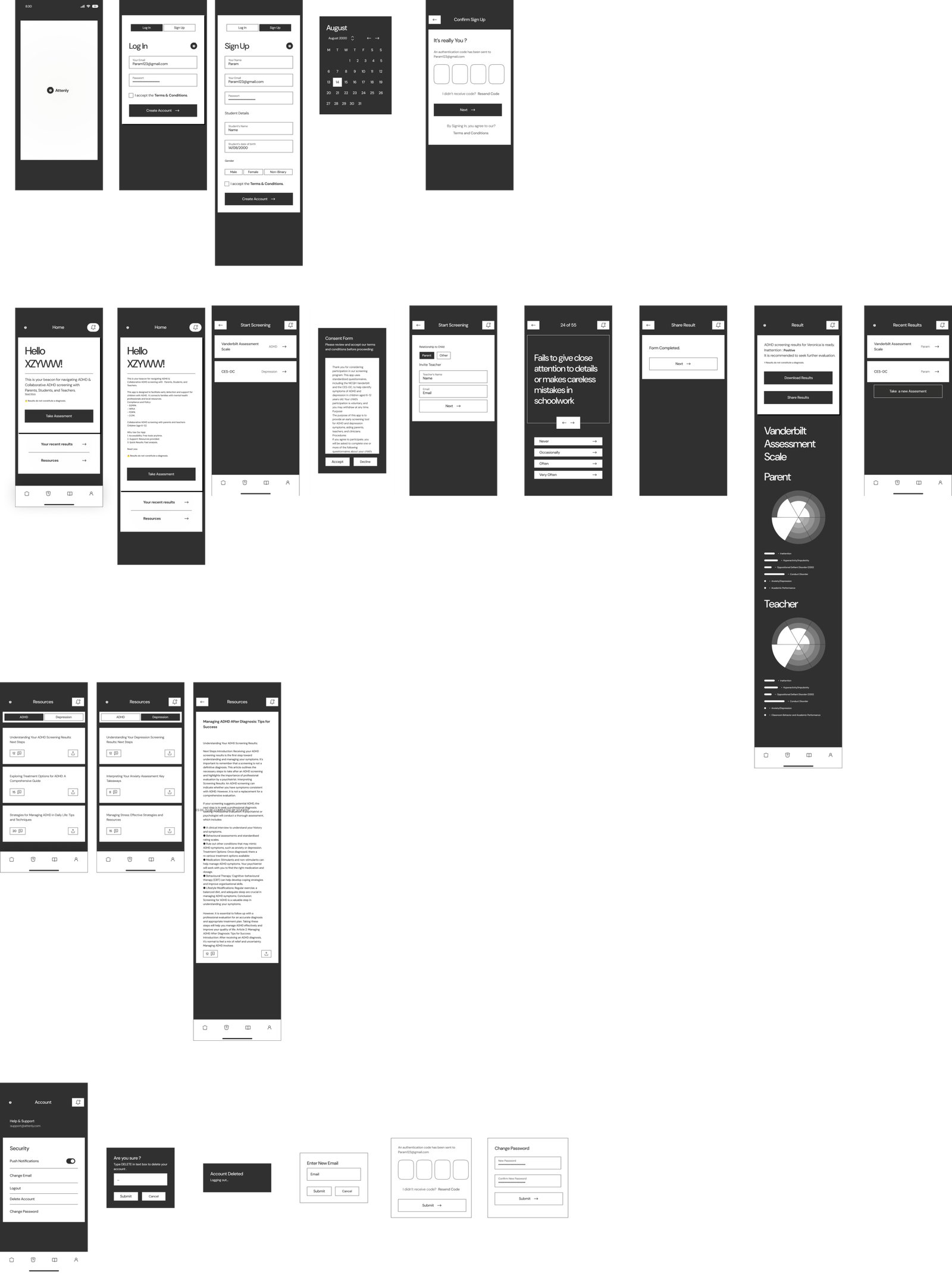
Low-Fidelity Wireframes

Low-Fidelity Wireframe Screens
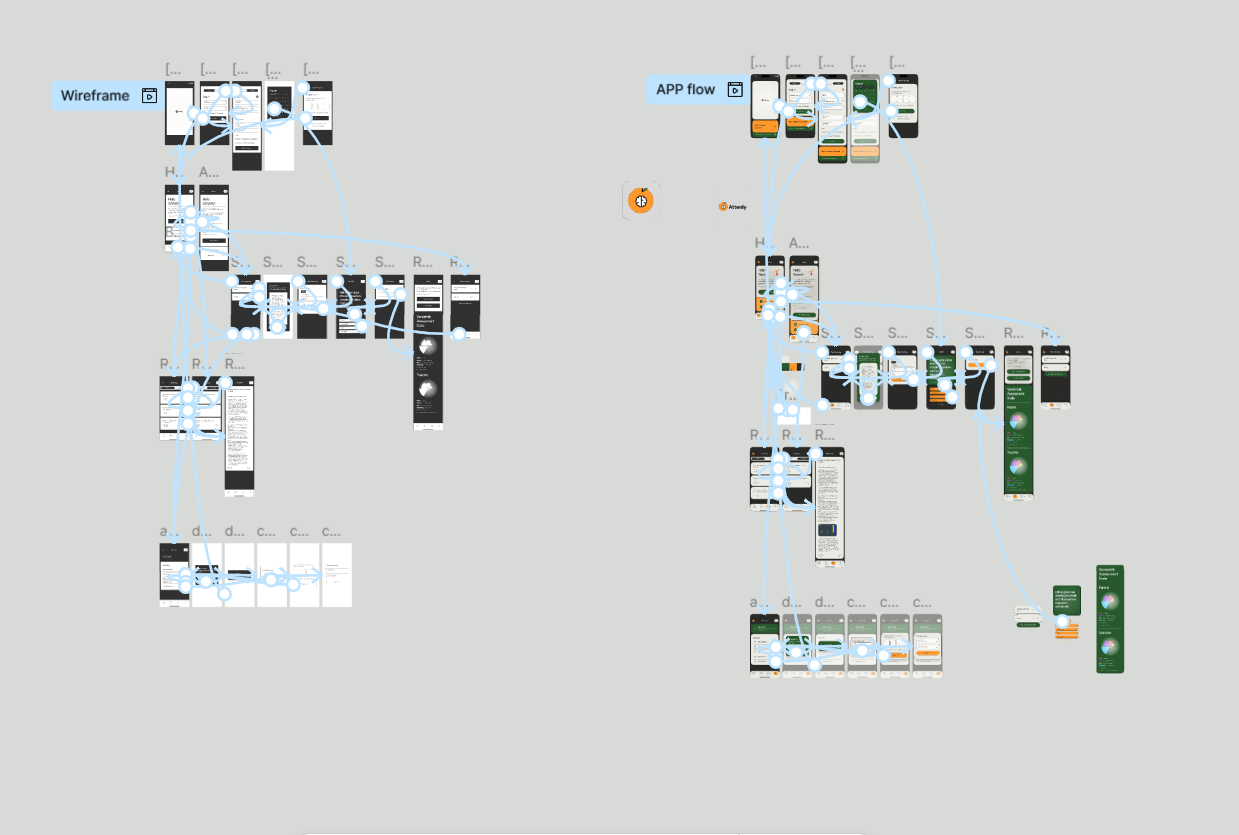
User Flow

Composite User Journey
Post Attenly

Scroll to explore
Stage
Early Awareness
Seeking Clarity
Screening & Assessment
Post-Screening
Teacher / Early Signs
Notices patterns without panic; inattention, not fear
Flags repeated behaviors without labeling
Uses Attenly’s classroom checklist
Shares results late; follows structured next step
Parent Awareness
Guided home inputs; feels supported
Stays with observation; reframes concern
Knows next step; structured assessment
Reassurance with clear information; reduced anxiety
Child Experience
Age-appropriate interactions with parents & teachers
Understanding relationship; strength in academic settings
Short, engaging screening; emotional validation
Behavior discussed inclusively; feels supported
Primary Care
Pre-visit screening data available
Confident contribution; professional clarity
Integrated tools; evidence-based next steps
Targeted assessment; timely referral
Counselor / Psychologist
Receives pre-assessment inputs from parents & teachers
Standardized tools; clear protocols
Combined screening; reduced wait times
Clear explanations; continuity of care
Opportunities
Normalize early consultation; shared vocabulary
Light-touch updates; reframe ADHD narrative
Encourages collaborative growth across stakeholders
Protective post-screening layer; ongoing support
Branding

Brand Identity

Color Palette

Deep Forest Green

Warm Orange

Charcoal

Soft Cream

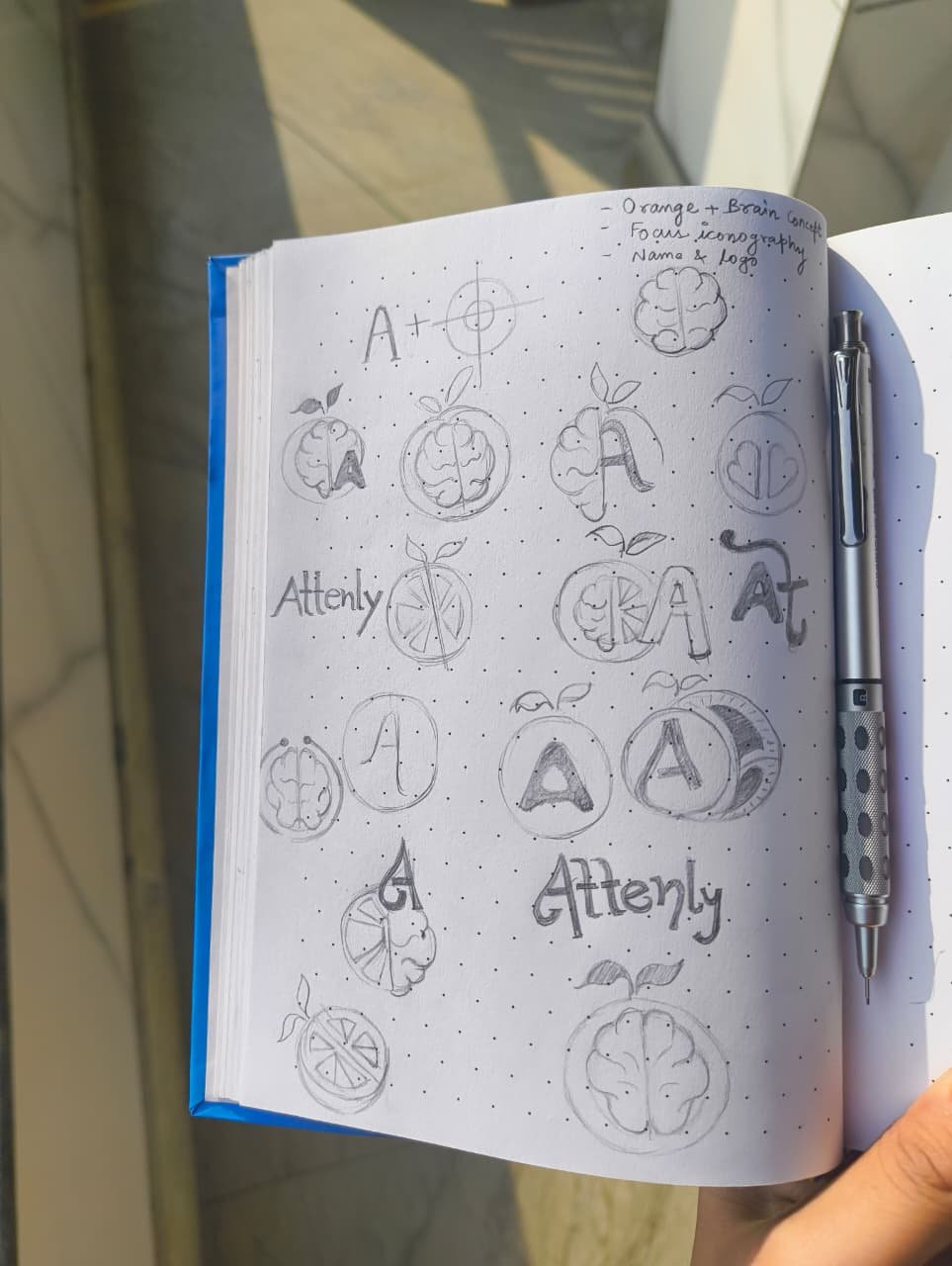
Attenly Logo
Attenly App Screenshot
Visual Design

Few Screens at Glimpse
High Fidelity
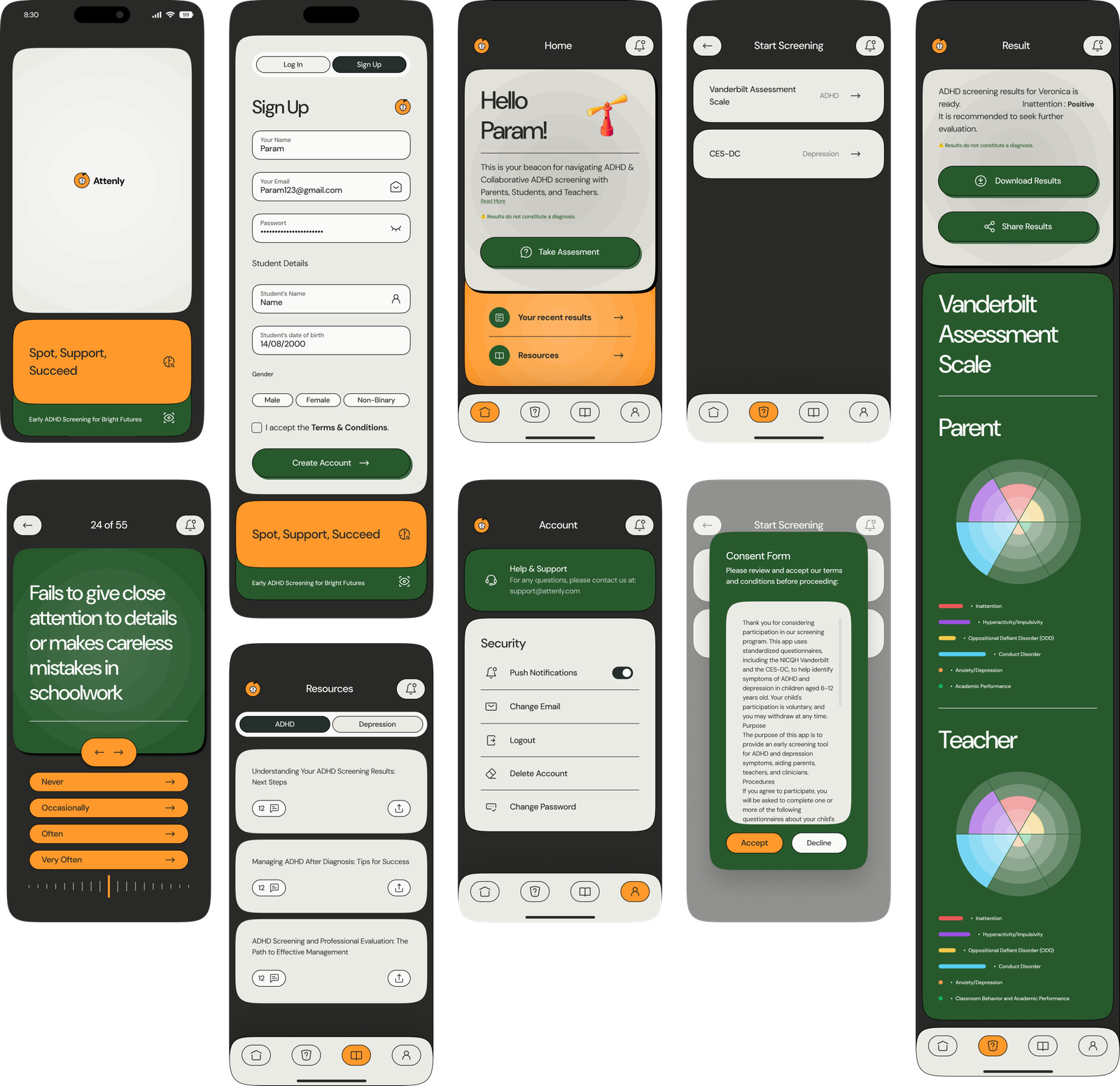
High Fidelity Screens
Interactive

Prototyping

Prototype Screens
Filter by
All Projects
Selected Works
Product Design
Academic Learning
Art & Illustrations
Internships
Side Explorations
Kritika Sharma